Roof System Types in Calabasas, CA
Expert Roof System Types in Calabasas, CA — Storm-Tested, Warranty-Backed
Discover the best roof system types in Calabasas, CA for fire zones, Santa Ana winds & Title 24. Call Apex Shield Roofing at (818) 714-8823 for a free estimate.
- Licensed & Insured
- Locally Owned & Operated
- Free Inspection & Estimate
Request Your
Free EstimateUnderstanding the different roof system types available in Calabasas, CA is the first step toward protecting your home or business from the region's demanding climate. A roof system encompasses not just the outermost layer of shingles or tiles, but the complete assembly of decking, underlayment, insulation, ventilation, and weatherproofing components working together to shield your property.
Calabasas presents unique environmental demands — from the searing heat of the Santa Monica Mountains foothills to the periodic brush fire smoke, heavy winter rains, and the infamous Santa Ana wind events that push through the Simi Hills corridor. Selecting the right roof system type for your specific property in Calabasas is not a one-size-fits-all decision.
At Apex Shield Roofing Repair Service CA, our team specializes in evaluating, installing, replacing, and maintaining every major roof system type used in the Calabasas area. Whether you own a Mediterranean-style estate in The Oaks, a modern ranch in Park Oaks, or a commercial property along Calabasas Road, we match the ideal roofing system to your building's architecture, budget, and long-term performance needs. Call us today at (818) 714-8823.
Understanding Roof System Types in Calabasas
A roofing system is far more than a surface material. It is a layered, engineered assembly designed to manage heat, water, wind, and structural load simultaneously. Roof system types are broadly categorized by their slope requirements, materials, installation methods, and performance characteristics. Calabasas property owners encounter a wide spectrum of these systems due to the city's architectural diversity — from the terracotta-tiled villas of the Las Virgenes corridor to flat-roofed contemporary homes tucked into the hillsides of Calabasas Park.
Primary Roof System Categories
Steep-Slope Systems (pitch greater than 2:12): These include concrete and clay tile roofs — the dominant aesthetic choice in Calabasas — as well as asphalt architectural shingles, wood shake, and metal panel systems. Steep-slope designs shed water rapidly, which is advantageous during Southern California's intense but brief winter rain events.
Low-Slope and Flat Systems (pitch 0:12 to 2:12): Common on commercial buildings along Calabasas Road and on modern residential designs in Calabasas Hills, these systems rely on continuous membrane barriers rather than gravity drainage. Options include TPO (Thermoplastic Polyolefin), EPDM (Ethylene Propylene Diene Monomer), modified bitumen, and built-up roofing (BUR).
Hybrid Systems: Many Calabasas properties feature split-level architecture that combines steep-slope tile sections over living areas with low-slope membrane sections over garages or additions. Managing the transition point between these two systems is a critical area of expertise.
Historically, the Calabasas area was developed in earnest during the 1970s through the 1990s, with significant luxury development continuing into the 2000s. Early construction favored concrete tile and asphalt shingles. More recent builds and remodels increasingly use cool-roof-compliant materials to satisfy California's Title 24 energy code requirements, which mandate minimum solar reflectance values for re-roofing projects. Understanding which system your existing roof represents — and which upgrade paths meet current code — is essential knowledge for every Calabasas property owner.
Learn more about our Roof Installation services
Why Selecting the Right Roof System Type Is Critical in Calabasas, CA
Santa Ana Wind Events and Wind-Driven Rain
The Santa Ana winds that funnel through the Simi Hills and down through the Las Virgenes Valley corridor routinely reach sustained speeds of 45 to 65 mph, with gusts recorded above 80 mph during major events. The November 2019 Easy Fire and the October 2019 Tick Fire both produced extreme wind events impacting the greater Calabasas area, with the National Weather Service issuing Particularly Dangerous Situation (PDS) Red Flag Warnings. Roof systems with inadequate fastening patterns, compromised underlayments, or missing hip-and-ridge cap units are highly vulnerable to catastrophic uplift during these events. Concrete tile systems, for example, must be installed with wind clips or mortar-set ridges in Calabasas to meet California Building Code wind uplift resistance standards for this wind zone.
Wildfire Ember Cast and Fire Resistance Requirements
Calabasas lies within and adjacent to Very High Fire Hazard Severity Zones (VHFHSZ) as designated by CAL FIRE. Neighborhoods including The Oaks at Calabasas, Calabasas Park Estates, and homes along Mulholland Highway in the Santa Monica Mountains face documented ember cast risk. The 2018 Woolsey Fire, which burned approximately 96,949 acres across Ventura and Los Angeles counties and came within miles of Calabasas residential communities, demonstrated how quickly ember transport can ignite roof assemblies. California's Title 24 and local fire codes require Class A fire-rated roof assemblies for new construction and re-roofing in VHFHSZ areas. Not all roof system types meet this threshold — untreated wood shake, for instance, does not qualify and is prohibited in these zones.
Thermal Cycling and the Calabasas Heat Load
Calabasas regularly experiences summer temperatures exceeding 100°F in the inland valleys, with the National Weather Service station at Calabasas recording heat events above 108°F in the summer of 2020. Rooftop surface temperatures on dark-colored asphalt shingles can exceed 160°F on peak days, dramatically accelerating thermal degradation. This extreme thermal cycling — from cold, wet December nights near 35°F to blistering August afternoons — causes repeated expansion and contraction stress on fasteners, sealants, and membrane flashings. Cool-roof rated materials with a minimum Solar Reflectance Index (SRI) of 78 for low-slope systems are now required under Title 24 for re-roofing in California, and they deliver measurable energy savings for Calabasas homeowners.
Clay-Rich Soils and Foundation Movement
The Las Virgenes Valley and the hillside terrain surrounding Calabasas contain expansive clay-rich soils classified in the Sorrento and Diablo soil series. These soils swell with moisture and contract during dry periods, causing differential foundation settlement. Even modest foundation movement — as little as 0.5 inches of differential settlement — can create ridge board deflection and valley racking that compromises tile alignment, opens flashing gaps, and cracks mortar-set ridges. Annual Roof Inspection services are critical to catch these stress-induced failures before interior water damage results.
Signs You Need Roof System Evaluation or Replacement in Calabasas
Visible Surface Indicators
- Cracked, slipped, or missing concrete or clay tiles — especially common after Santa Ana wind events above 50 mph
- Granule loss forming deposits in gutters, indicating asphalt shingle end-of-life
- Blistering, bubbling, or alligatoring on flat or low-slope membrane surfaces
- Darkened streaks or algae growth patterns on north-facing slopes
- Visible daylight through ridge vents or hip caps when viewed from the attic
Interior Warning Signs
- Water stains on ceiling drywall or attic sheathing, particularly appearing after December–March rain events
- Musty odors in attic spaces suggesting trapped moisture and mold growth
- Sagging or soft spots in roof decking detected from the attic
- Increased utility bills in summer suggesting failed attic ventilation or degraded insulation from moisture intrusion
Urgent Red Flags
- Active water infiltration during rainfall — requires same-day emergency response
- Large sections of lifted or displaced tile following high-wind events
- Collapsed or heavily sagging ridge line visible from street level
If you observe any of the above, contact Apex Shield Roofing Repair Service CA immediately at (818) 714-8823 for a professional assessment. Learn about our Emergency Roofing services
Our Roof System Evaluation and Installation Process in Calabasas
At Apex Shield Roofing Repair Service CA, we follow a structured, transparent process tailored to Calabasas properties and local code requirements.
Initial Consultation and Site Visit (Day 1 — 1 to 2 hours)
We schedule a property visit to visually assess your existing roof system from the exterior and interior attic. We document slope angles, existing system type, age, flashings, ventilation configuration, and any visible damage. For Calabasas hillside properties, we also assess access requirements for scaffolding or safety anchoring on pitches above 6:12.
Detailed Written Inspection Report (Days 1–2)
We deliver a written report identifying the existing roof system type, condition rating, remaining service life estimate, and documented deficiencies. We note VHFHSZ status and Title 24 Cool Roof compliance requirements applicable to your specific Calabasas parcel. View our full Roof Inspection process
Roof System Selection and Proposal (Days 2–4)
We present 2–3 roof system options matched to your building's slope, architectural style, fire zone designation, HOA guidelines (critical for communities like The Oaks at Calabasas, which has strict aesthetic standards), and budget. Each proposal includes material specifications, manufacturer data sheets, and estimated energy performance data.
Permitting (Days 3–10)
We submit roof permit applications to the City of Calabasas Building and Safety Division on your behalf. Permit processing typically takes 5–10 business days for standard re-roofing projects in Calabasas. We include all required Title 24 compliance documentation and VHFHSZ fire rating certifications.
Tear-Off and Deck Preparation (Day 1 of Installation — 1 to 2 days)
Existing materials are removed and disposed of per Los Angeles County waste management regulations. Decking is inspected for rot, delamination, or structural deflection — particularly at valley intersections and around penetrations where Calabasas's clay soil movement is most likely to have caused stress cracking.
System Installation (2 to 5 days depending on system and roof area)
Underlayment, flashings, primary roofing material, ridge ventilation, and all penetration seals are installed per manufacturer specifications and California Building Code. Santa Ana wind-resistant fastening patterns are standard on all Calabasas installations.
Final Inspection and Permit Sign-Off (Within 3 days of completion)
City of Calabasas building inspector performs final approval. We walk the completed roof with you, review warranty documentation, and provide a maintenance schedule customized to your new system type.
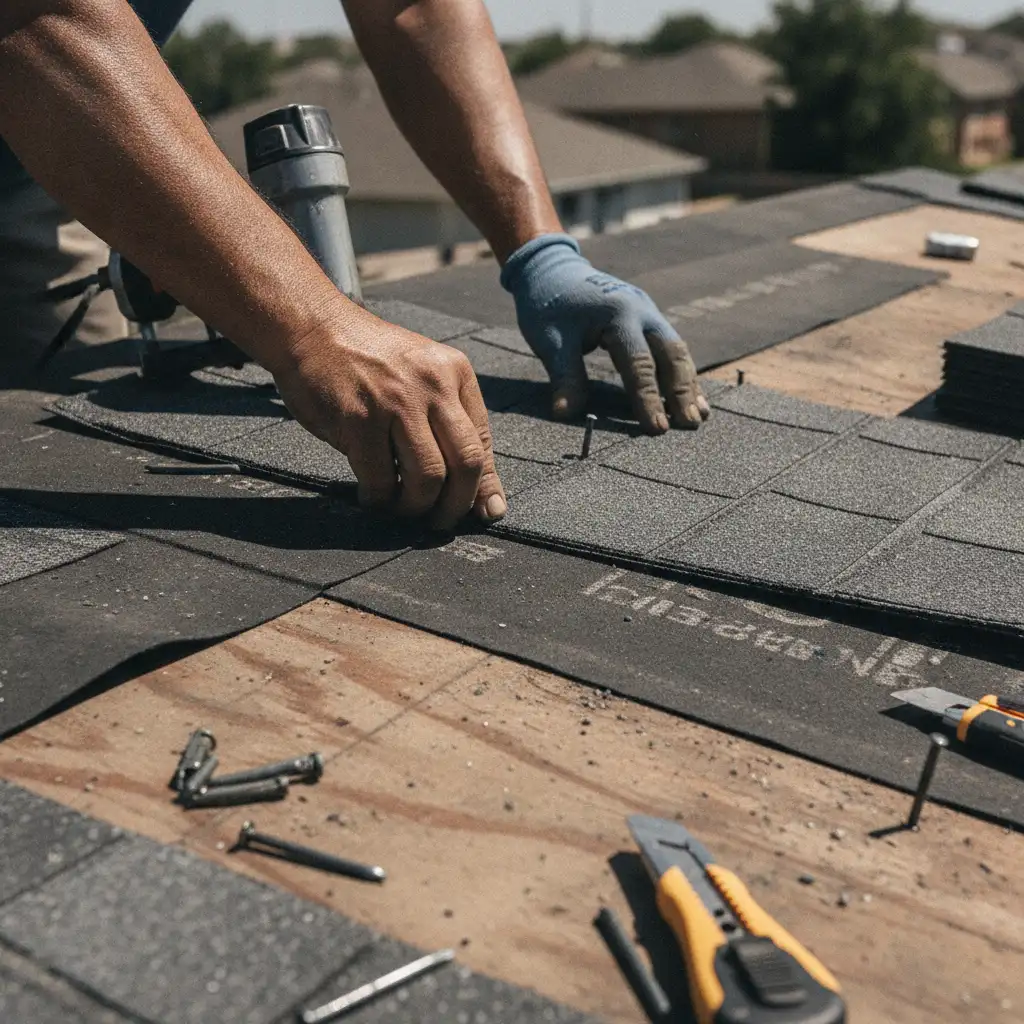
Our team in action — roof-repair professionals serving Calabasas
Roof System Methods and Approaches Used in Calabasas
1. Concrete and Clay Tile Systems
The dominant roof system type in Calabasas's luxury residential communities. Concrete tile offers a 40–50 year service life and is available in profiles that satisfy HOA aesthetic requirements in communities like The Oaks and Calabasas Park Estates. Clay tile performs similarly but at a premium price. Both require wind-clip installation at eaves and ridges to resist Santa Ana uplift forces in Calabasas's wind zone. These systems also require a high-performance synthetic underlayment — typically a minimum 40-mil product — beneath the tile for fire and water resistance.
2. Cool-Roof Asphalt Architectural Shingles
A cost-effective alternative for Calabasas properties not restricted to tile by HOA rules. Title 24-compliant shingles with an SRI of 29 or greater are required for re-roofing in California's Climate Zone 9, which covers Calabasas. These are ideal for 1970s and 1980s tract homes in Calabasas Park where tile is not mandatory.
3. TPO Membrane Systems (Low-Slope)
The preferred choice for Calabasas commercial properties along Calabasas Road and Las Virgenes Road, as well as modern flat-roof residential designs. White TPO membranes deliver solar reflectance values above 0.80, substantially reducing summer cooling loads in Calabasas's 100°F+ heat events.
4. Metal Standing Seam Roofing
Increasingly popular in Calabasas's contemporary hillside architecture. Class A fire rated, 50+ year service life, and excellent performance in both wind and fire ember scenarios. Particularly well-suited for VHFHSZ-designated properties near Mulholland Highway.
5. Modified Bitumen Systems
Used on low-slope sections of split-level Calabasas homes and on commercial flat roofs. Torch-applied or self-adhered systems provide redundant waterproofing layers — critical in areas where winter rainfall intensity in the Santa Monica Mountains can produce 1–2 inches of rain in under an hour. Explore our Commercial Roofing services
Ready for Roof System Types? Get Your Free Estimate Today.
Apex Shield Roofing Repair Service CA serves Calabasas and the surrounding area — we'll be on-site within 24 hours.
📞 Call (818) 714-8823Roof System Types Cost in Calabasas, CA
Roof system costs in Calabasas reflect the region's premium labor market, fire zone compliance requirements, and the architectural complexity of local buildings. Below are current typical price ranges for common systems:
- Concrete Tile Re-Roofing: $18,000–$45,000 for a typical 2,000–3,500 sq ft Calabasas home, depending on pitch and existing underlayment condition. Tile material alone ranges from $4.50–$9.00 per square foot installed.
- Clay Tile Re-Roofing: $25,000–$65,000 for comparable homes. Premium clay tile product costs $8.00–$15.00 per square foot installed.
- Asphalt Architectural Shingles: $10,000–$22,000 for a typical Calabasas residence. Material and labor combined typically run $5.50–$8.50 per square foot.
- Standing Seam Metal: $28,000–$70,000 depending on panel profile, finish, and roof complexity. Metal systems carry higher upfront costs but the lowest long-term lifecycle cost.
- TPO Flat Roof (Commercial): $6.00–$12.00 per square foot installed, with total project costs typically $15,000–$60,000+ depending on building size.
Calabasas-Specific Cost Factors
- Permitting fees: City of Calabasas roofing permits typically range from $450–$1,200 depending on project value.
- HOA approval process: May add 1–3 weeks and require specific material samples for communities like The Oaks at Calabasas.
- Hillside access: Steep-lot homes may require specialized scaffolding, adding $1,500–$4,000 to project costs.
- Deck replacement: If moisture or foundation movement has damaged decking, budget an additional $2.50–$4.50 per square foot for OSB or plywood replacement.
Contact us at (818) 714-8823 for a no-obligation estimate. View our full Roof Replacement options
Neighborhoods We Serve in Calabasas, CA
The Oaks at Calabasas
One of Calabasas's most prestigious gated communities, developed primarily between 1998 and 2010. Homes feature large Mediterranean and Spanish Colonial tile roofs averaging 3,500–5,500 sq ft of roof surface. The Oaks HOA enforces strict material and color standards, requiring pre-approved concrete or clay tile profiles. Our team is experienced navigating the HOA approval process for this community.
Calabasas Park Estates
Built predominantly in the 1980s and early 1990s, these homes often feature original concrete tile roofs now approaching or exceeding their 30–35 year service life. Underlayment degradation beneath aged tile is the most common issue we address here, along with mortar-set ridge failures.
Park Oaks / Calabasas Hills
A mix of 1970s ranch-style and later contemporary builds. Many properties in this area feature combination steep-slope/flat roof configurations. Flat-to-pitched transition flashing failures are a documented recurring issue in this neighborhood's aging housing stock.
Mulholland Corridor and Las Virgenes Canyon
Rural residential properties along Mulholland Highway and adjacent canyon roads sit firmly within VHFHSZ boundaries. Class A fire-rated systems — metal or tile — are mandatory and our primary recommendation for every re-roofing project in this corridor.
Roof Maintenance Tips for Calabasas Property Owners
- Inspect after every Santa Ana wind event. Walk the perimeter of your home and look for displaced tiles, lifted shingles, or debris on the roof surface. Even minor tile slippage creates underlayment exposure.
- Clear gutters before the November–December rainy season. Sycamore and oak leaf debris from the Las Virgenes Valley trees can block downspouts, causing water to back up under eave tiles.
- Trim tree branches to maintain a 10-foot clearance from the roof surface. Overhanging limbs deposit debris, retain moisture, and pose a direct ember ignition risk during fire weather.
- Schedule a professional inspection every 12 months. Calabasas's thermal cycling alone warrants annual sealant and flashing checks. View our Roof Maintenance plans
- Check attic ventilation quarterly. Blocked ridge or soffit vents in Calabasas's summer heat can push attic temperatures above 160°F, cooking underlayment and shortening roof system life by years.
- Re-apply mortar at ridge and hip caps every 8–12 years. Thermal expansion and soil movement from Calabasas's clay-rich ground regularly crack traditional mortar-set ridges on tile roofs.
- Document your roof after installation with dated photographs. This is invaluable for insurance claims following wildfire smoke or wind damage events common to the Calabasas area.
Why Choose Apex Shield Roofing Repair Service CA in Calabasas
Apex Shield Roofing Repair Service CA is dedicated exclusively to serving Calabasas and the surrounding communities of the western San Fernando Valley and Santa Monica Mountains corridor. Our team understands the specific intersection of HOA requirements, VHFHSZ fire zone mandates, Title 24 Cool Roof compliance, and Santa Ana wind resistance standards that govern every roofing project in Calabasas.
We work with every major roof system type used in this region — from the terracotta tile profiles required by The Oaks at Calabasas HOA to the TPO membrane systems demanded by commercial properties along Calabasas Road. Our familiarity with City of Calabasas Building and Safety Division permitting processes means smoother project timelines for our clients.
We offer Roof Repair, Roof Installation, Roof Replacement, Roof Inspection, Roof Maintenance, Commercial Roofing, and Emergency Roofing services — a complete capability set that means you will never need to call a second contractor. When Calabasas faces a Red Flag Warning and your roof is compromised, we answer the phone. Call (818) 714-8823 today to schedule your consultation.
Learn about our Roof Repair services
Frequently Asked Questions: Roof System Types in Calabasas, CA
Q: What is the most common roof system type in Calabasas?
A: Concrete tile is by far the most prevalent roof system type in Calabasas, installed on the majority of the city's residential housing stock built since the 1980s. Clay tile is also common in luxury segments. Both systems are well-suited to Calabasas's climate when properly installed with modern high-performance underlayments and wind-resistant fastening.
Q: Do I need a special roof system because of the wildfire risk in Calabasas?
A: Yes. Properties in Calabasas's Very High Fire Hazard Severity Zones — which include significant portions of the city, particularly west of Las Virgenes Road and along the Mulholland corridor — are required by California law to use Class A fire-rated roof assemblies for any re-roofing project. Concrete tile, clay tile, metal, and certain asphalt shingles qualify. We verify your parcel's fire zone status at no charge during our initial consultation.
Q: How much does a typical roof replacement cost in Calabasas?
A: Costs vary significantly by system type and property size. For the most common scenario — a 2,500 sq ft Calabasas home with a concrete tile re-roof — expect a range of $22,000–$38,000 including materials, labor, permit fees, and underlayment replacement. We provide detailed written estimates with no obligation. Call (818) 714-8823 to schedule your assessment.
Q: Does my Calabasas HOA restrict which roof system I can choose?
A: Many of Calabasas's gated communities, including The Oaks at Calabasas and Calabasas Park Estates, have Architectural Review Committee (ARC) guidelines that specify approved tile profiles, colors, and materials. We are familiar with the standards of major local HOAs and routinely prepare ARC submission packages on behalf of our clients. We recommend confirming HOA requirements before finalizing any roof system selection.
Q: How long does a roof replacement take in Calabasas?
A: For a standard residential tile re-roof, the installation phase typically takes 3–7 days once materials are on-site. Add 5–10 business days for City of Calabasas permit processing before work can begin. Total project timelines from contract signing to permit sign-off typically run 3–5 weeks. Emergency repairs under a temporary permit can begin within 24–48 hours.
Q: What does Title 24 Cool Roof compliance mean for my Calabasas re-roofing project?
A: California's Title 24 Energy Code requires re-roofing projects to use materials meeting minimum solar reflectance and thermal emittance values. For low-slope roofs in Calabasas's Climate Zone 9, this means a minimum Solar Reflectance Index of 78. For steep-slope roofs, a minimum SRI of 16 is required (though higher-performance products are available). Cool roof-compliant materials reduce summer attic temperatures significantly — an important energy savings measure given Calabasas's 100°F+ summer heat. We only specify Title 24-compliant products on all our projects.
Q: Can you replace just part of my roof, or does the whole system need to come off?
A: Partial replacement is sometimes appropriate for localized damage — for example, tiles displaced by a Santa Ana wind event over a small section of the roof. However, if the underlying underlayment is degraded (common in Calabasas tile roofs more than 20–25 years old), full replacement of the affected section including underlayment is strongly recommended to prevent future water intrusion. We will give you an honest assessment of whether a repair or full replacement best serves your long-term interests.
Q: Do you serve commercial properties in Calabasas?
A: Absolutely. We provide full Commercial Roofing services for office buildings, retail centers, and multi-unit properties throughout Calabasas, including along Calabasas Road, Agoura Road, and the Las Virgenes commercial corridors. TPO, EPDM, modified bitumen, and metal panel systems are all within our commercial capabilities.
Get Expert Roof System Guidance in Calabasas, CA Today
Your Calabasas property faces a demanding combination of Santa Ana wind events, wildfire ember risk, extreme thermal cycling, and HOA compliance requirements that demand precisely the right roof system — expertly installed. Don't leave this critical decision to guesswork or an out-of-area contractor unfamiliar with Calabasas's unique conditions.
Apex Shield Roofing Repair Service CA is ready to evaluate your existing roof system, identify your best replacement or repair options, and guide your project from permit application through final inspection. We serve all Calabasas neighborhoods including The Oaks, Calabasas Park Estates, Calabasas Hills, and the Mulholland corridor.
Call us now at (818) 714-8823 to schedule your professional roof system evaluation. You can also reach us online to request a written estimate. Protect your Calabasas property with a roof system built for this community.
Request Your Free Roof System Estimate Today